

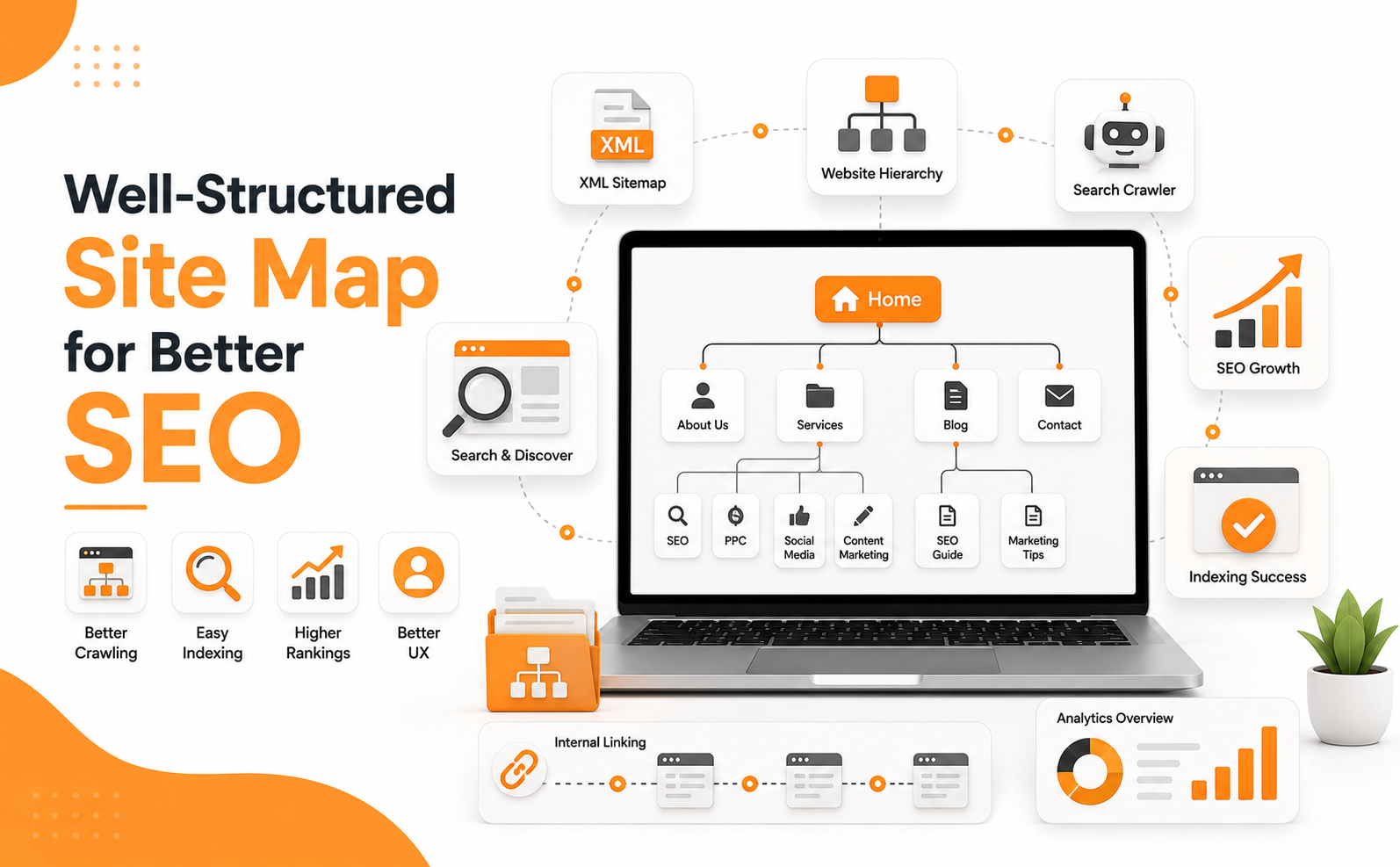
In today’s competitive digital landscape, having a visually appealing website is no longer enough. Search engines need to understand your website’s structure before they can rank your pages effectively. This is where a Well-Structured Site Map becomes an essential part of your SEO strategy.
A sitemap acts as a roadmap for search engines, helping them discover, crawl, and index your website’s pages more efficiently. Whether you own a business website, an eCommerce store, or a blog, a Well-Structured Site Map improves navigation for both search engines and users, making it easier for valuable content to be found.
Businesses that overlook their website structure often experience slower indexing, poor visibility, and missed opportunities to attract organic traffic. On the other hand, a properly organised sitemap supports better search engine understanding, improved user experience, and long-term SEO success.
In this guide, you’ll learn how a Well-Structured Site Map strengthens your SEO strategy, the different types of sitemaps, and the best practices for creating one in 2026.
Why a Well-Structured Site Map Matters for SEO
A website may contain hundreds or even thousands of pages. Without a clear structure, search engines can struggle to discover important pages, especially those buried deep within your website.
A Well-Structured Site Map provides search engines with a clear overview of your website and helps ensure important pages are indexed correctly.
Some of the biggest benefits include:
- Faster website crawling
- Improved page indexing
- Better search engine visibility
- Enhanced website navigation
- Stronger internal linking
- Better user experience
- Increased organic traffic
According to search engine documentation, submitting a sitemap helps search engines understand your website more efficiently, particularly for large or newly launched websites.
1. What Is a Well-Structured Site Map?
A Well-Structured Site Map is an organised file or webpage that lists the important pages on your website in a logical hierarchy. It helps search engines discover and understand your website’s content while making navigation easier for users.
There are two primary types of sitemaps:
XML Sitemap
An XML sitemap is designed specifically for search engines. It contains important URLs that search engines should crawl and index.
XML sitemaps typically include:
- Website URLs
- Last modification dates
- Update frequency
- Page priority
Submitting an XML sitemap through Google Search Console helps Google discover newly added or updated pages more efficiently.
HTML Sitemap
Unlike XML sitemaps, HTML sitemaps are created for website visitors.
They help users:
- Navigate your website easily
- Discover important pages
- Improve overall browsing experience
- Access information quickly
An HTML sitemap is especially useful for websites with large amounts of content.
2. How a Well-Structured Site Map Improves SEO
A properly organised sitemap supports multiple aspects of search engine optimisation.
Faster Crawling
Search engines use automated bots to crawl websites. A Well-Structured Site Map provides these bots with a clear path to your content, reducing the chances of important pages being missed.
This is particularly helpful for:
- New websites
- Large websites
- Frequently updated websites
- eCommerce stores
Better Indexing
Not every page on a website is automatically indexed.
A sitemap tells search engines which pages are important and should appear in search results.
Following sitemap guidelines helps improve indexing efficiency and ensures valuable content receives proper visibility.
Improved Website Architecture
A Well-Structured Site Map encourages logical website organisation.
For example:
Home
│
├── Services
│     ├── SEO
│     ├── Google Ads
│     ├── Social Media Marketing
│
├── Blog
│     ├── SEO Blogs
│     ├── PPC Blogs
│     ├── Content Marketing Blogs
│
├── About
│
└── Contact
A clear hierarchy makes it easier for both users and search engines to understand relationships between pages.
3. Enhancing User Experience with a Well-Structured Site Map
SEO is no longer just about search engines. User experience has become one of Google’s most important ranking factors.
A Well-Structured Site Map improves user experience by helping visitors quickly locate relevant information without unnecessary clicks.
Benefits include:
- Easier navigation
- Reduced bounce rates
- Better page discovery
- Improved accessibility
- Higher engagement
Visitors who can easily find information are more likely to stay on your website, explore multiple pages, and convert into customers.
4. Strengthening Internal Linking
Internal linking is one of the most overlooked SEO strategies.
A Well-Structured Site Map naturally supports strong internal linking by organising pages into logical categories.
Examples include linking:
- Blog articles to related services
- Service pages to case studies
- Product pages to buying guides
- FAQs to relevant landing pages
Following SEO best practices for internal linking helps distribute authority across your website and improves crawlability.
5. Helping Search Engines Discover New Content
Whenever you publish a new blog, service page, or landing page, search engines need to discover it before it can appear in search results.
Updating your Well-Structured Site Map makes it easier for search engines to identify newly published content.
This is especially important for businesses that:
- Publish blogs regularly
- Add new products frequently
- Update service pages
- Launch seasonal campaigns
Submitting updated sitemaps through Google Search Console ensures search engines are notified about important changes.
6. Monitoring Site Performance
Creating a sitemap is only the beginning. Regular monitoring helps ensure your website continues performing efficiently.
Using Google Search Console allows you to:
- Submit XML sitemaps
- Monitor indexing status
- Detect crawl errors
- Identify broken pages
- Review coverage reports
You should also analyse website speed using PageSpeed Insights, as fast-loading websites provide a better user experience and support stronger SEO performance.
7. Common Sitemap Mistakes to Avoid
Even if you have a sitemap, certain mistakes can reduce its effectiveness and negatively impact your SEO. A Well-Structured Site Map should always be accurate, updated, and aligned with your website’s content.
Avoid these common mistakes:
- Including broken or redirected URLs
- Adding duplicate pages
- Forgetting to update the sitemap after publishing new content
- Blocking important pages with robots.txt
- Including “noindex” pages in the sitemap
- Creating a confusing website hierarchy
- Ignoring internal linking opportunities
Regularly reviewing your sitemap helps search engines crawl your website more efficiently and prevents indexing issues.
8. Best Practices for Creating a Well-Structured Site Map
A Well-Structured Site Map is most effective when it follows SEO best practices and provides clear guidance to both users and search engines.
Keep Your Website Hierarchy Simple
Organize your pages into logical categories with a clear structure.
Example:
- Home
- About Us
- Services
- SEO Services
- Google Ads
- Social Media Marketing
- Blog
- Contact
A simple hierarchy improves crawlability and user navigation.
Include Only Important Pages
Your sitemap should contain pages that provide value to users and are intended to appear in search results.
Avoid adding:
- Duplicate pages
- Admin pages
- Thank-you pages
- Test pages
- Noindex URLs
Following sitemap guidelines ensures your sitemap remains clean and optimised.
Update Your Sitemap Regularly
Whenever you publish:
- New blog posts
- Service pages
- Landing pages
- Product pages
Update your sitemap and resubmit it through Google Search Console
Optimize Internal Linking
A sitemap works best when supported by a strong internal linking strategy. Link related blogs, service pages, case studies, and FAQs to help search engines understand your website’s structure.
9. How a Well-Structured Site Map Supports Long-Term SEO Growth
SEO is a long-term strategy, and a Well-Structured Site Map plays an important role in maintaining consistent website performance over time.
Benefits include:
Faster Indexing of New Content
When you publish new pages, an updated sitemap helps search engines discover them more quickly, allowing your content to appear in search results sooner.
Better Crawl Efficiency
Search engine bots have a limited crawl budget. A properly organised sitemap helps them prioritise important pages instead of wasting resources on unnecessary URLs.
Improved Website Authority
A logical site structure combined with strong internal linking helps distribute authority across your website, improving the visibility of important pages.
Better User Experience
Visitors can navigate your website more easily, reducing bounce rates and increasing the likelihood of exploring additional pages.
Using SEO best practices alongside a well-organised sitemap creates a strong foundation for sustainable organic growth.
10. Essential Tools for Managing Your Sitemap
Several tools can help you create, submit, and monitor a Well-Structured Site Map.
Google Search Console
Use it to:
- Submit XML sitemaps
- Monitor indexing status
- Identify crawl errors
- Review coverage reports
Google PageSpeed Insights
A sitemap works best alongside a fast-loading website. PageSpeed Insights helps identify performance issues that may affect user experience and search rankings.
XML Sitemap Generator
If your website platform doesn’t automatically generate a sitemap, you can use an XML Sitemap Generator to create one quickly.
SEO Audit Tools
Regular website audits help identify broken links, duplicate content, crawl issues, and other technical SEO problems before they affect your rankings.
Conclusion
A Well-Structured Site Map is much more than a technical SEO requirement it’s the foundation of a website that is easy for both users and search engines to navigate. By organising your website effectively, you improve crawlability, indexing, internal linking, and the overall user experience.
Following SEO best practices and regularly monitoring your website through Google Search Console can significantly improve your SEO performance over time.
Businesses that maintain a Well-Structured Site Map are more likely to achieve stronger search visibility, attract qualified organic traffic, and build a website that supports long-term digital growth.
Ready to Improve Your Website's SEO?
In today’s competitive digital landscape, having a visually appealing website is no longer enough. Search engines need to understand your website’s structure before they can rank your pages effectively. This is where a Well-Structured Site Map becomes an essential part of your SEO strategy.
A sitemap acts as a roadmap for search engines, helping them discover, crawl, and index your website’s pages more efficiently. Whether you own a business website, an eCommerce store, or a blog, a Well-Structured Site Map improves navigation for both search engines and users, making it easier for valuable content to be found.
Businesses that overlook their website structure often experience slower indexing, poor visibility, and missed opportunities to attract organic traffic. On the other hand, a properly organised sitemap supports better search engine understanding, improved user experience, and long-term SEO success.
In this guide, you’ll learn how a Well-Structured Site Map strengthens your SEO strategy, the different types of sitemaps, and the best practices for creating one in 2026.
Why a Well-Structured Site Map Matters for SEO
A website may contain hundreds or even thousands of pages. Without a clear structure, search engines can struggle to discover important pages, especially those buried deep within your website.
A Well-Structured Site Map provides search engines with a clear overview of your website and helps ensure important pages are indexed correctly.
Some of the biggest benefits include:
- Faster website crawling
- Improved page indexing
- Better search engine visibility
- Enhanced website navigation
- Stronger internal linking
- Better user experience
- Increased organic traffic
According to search engine documentation, submitting a sitemap helps search engines understand your website more efficiently, particularly for large or newly launched websites.
1. What Is a Well-Structured Site Map?
A Well-Structured Site Map is an organised file or webpage that lists the important pages on your website in a logical hierarchy. It helps search engines discover and understand your website’s content while making navigation easier for users.
There are two primary types of sitemaps:
XML Sitemap
An XML sitemap is designed specifically for search engines. It contains important URLs that search engines should crawl and index.
XML sitemaps typically include:
- Website URLs
- Last modification dates
- Update frequency
- Page priority
Submitting an XML sitemap through Google Search Console helps Google discover newly added or updated pages more efficiently.
HTML Sitemap
Unlike XML sitemaps, HTML sitemaps are created for website visitors.
They help users:
- Navigate your website easily
- Discover important pages
- Improve overall browsing experience
- Access information quickly
An HTML sitemap is especially useful for websites with large amounts of content.
2. How a Well-Structured Site Map Improves SEO
A properly organised sitemap supports multiple aspects of search engine optimisation.
Faster Crawling
Search engines use automated bots to crawl websites. A Well-Structured Site Map provides these bots with a clear path to your content, reducing the chances of important pages being missed.
This is particularly helpful for:
- New websites
- Large websites
- Frequently updated websites
- eCommerce stores
Better Indexing
Not every page on a website is automatically indexed.
A sitemap tells search engines which pages are important and should appear in search results.
Following sitemap guidelines helps improve indexing efficiency and ensures valuable content receives proper visibility.
Improved Website Architecture
A Well-Structured Site Map encourages logical website organisation.
For example:
Home
│
├── Services
│     ├── SEO
│     ├── Google Ads
│     ├── Social Media Marketing
│
├── Blog
│     ├── SEO Blogs
│     ├── PPC Blogs
│     ├── Content Marketing Blogs
│
├── About
│
└── Contact
A clear hierarchy makes it easier for both users and search engines to understand relationships between pages.
3. Enhancing User Experience with a Well-Structured Site Map
SEO is no longer just about search engines. User experience has become one of Google’s most important ranking factors.
A Well-Structured Site Map improves user experience by helping visitors quickly locate relevant information without unnecessary clicks.
Benefits include:
- Easier navigation
- Reduced bounce rates
- Better page discovery
- Improved accessibility
- Higher engagement
Visitors who can easily find information are more likely to stay on your website, explore multiple pages, and convert into customers.
4. Strengthening Internal Linking
Internal linking is one of the most overlooked SEO strategies.
A Well-Structured Site Map naturally supports strong internal linking by organising pages into logical categories.
Examples include linking:
- Blog articles to related services
- Service pages to case studies
- Product pages to buying guides
- FAQs to relevant landing pages
Following SEO best practices for internal linking helps distribute authority across your website and improves crawlability.
5. Helping Search Engines Discover New Content
Whenever you publish a new blog, service page, or landing page, search engines need to discover it before it can appear in search results.
Updating your Well-Structured Site Map makes it easier for search engines to identify newly published content.
This is especially important for businesses that:
- Publish blogs regularly
- Add new products frequently
- Update service pages
- Launch seasonal campaigns
Submitting updated sitemaps through Google Search Console ensures search engines are notified about important changes.
6. Monitoring Site Performance
Creating a sitemap is only the beginning. Regular monitoring helps ensure your website continues performing efficiently.
Using Google Search Console allows you to:
- Submit XML sitemaps
- Monitor indexing status
- Detect crawl errors
- Identify broken pages
- Review coverage reports
You should also analyse website speed using PageSpeed Insights, as fast-loading websites provide a better user experience and support stronger SEO performance.
7. Common Sitemap Mistakes to Avoid
Even if you have a sitemap, certain mistakes can reduce its effectiveness and negatively impact your SEO. A Well-Structured Site Map should always be accurate, updated, and aligned with your website’s content.
Avoid these common mistakes:
- Including broken or redirected URLs
- Adding duplicate pages
- Forgetting to update the sitemap after publishing new content
- Blocking important pages with robots.txt
- Including “noindex” pages in the sitemap
- Creating a confusing website hierarchy
- Ignoring internal linking opportunities
Regularly reviewing your sitemap helps search engines crawl your website more efficiently and prevents indexing issues.
8. Best Practices for Creating a Well-Structured Site Map
A Well-Structured Site Map is most effective when it follows SEO best practices and provides clear guidance to both users and search engines.
Keep Your Website Hierarchy Simple
Organize your pages into logical categories with a clear structure.
Example:
- Home
- About Us
- Services
- SEO Services
- Google Ads
- Social Media Marketing
- Blog
- Contact
A simple hierarchy improves crawlability and user navigation.
Include Only Important Pages
Your sitemap should contain pages that provide value to users and are intended to appear in search results.
Avoid adding:
- Duplicate pages
- Admin pages
- Thank-you pages
- Test pages
- Noindex URLs
Following sitemap guidelines ensures your sitemap remains clean and optimised.
Update Your Sitemap Regularly
Whenever you publish:
- New blog posts
- Service pages
- Landing pages
- Product pages
Update your sitemap and resubmit it through Google Search Console
Optimize Internal Linking
A sitemap works best when supported by a strong internal linking strategy. Link related blogs, service pages, case studies, and FAQs to help search engines understand your website’s structure.
9. How a Well-Structured Site Map Supports Long-Term SEO Growth
SEO is a long-term strategy, and a Well-Structured Site Map plays an important role in maintaining consistent website performance over time.
Benefits include:
Faster Indexing of New Content
When you publish new pages, an updated sitemap helps search engines discover them more quickly, allowing your content to appear in search results sooner.
Better Crawl Efficiency
Search engine bots have a limited crawl budget. A properly organised sitemap helps them prioritise important pages instead of wasting resources on unnecessary URLs.
Improved Website Authority
A logical site structure combined with strong internal linking helps distribute authority across your website, improving the visibility of important pages.
Better User Experience
Visitors can navigate your website more easily, reducing bounce rates and increasing the likelihood of exploring additional pages.
Using SEO best practices alongside a well-organised sitemap creates a strong foundation for sustainable organic growth.
10. Essential Tools for Managing Your Sitemap
Several tools can help you create, submit, and monitor a Well-Structured Site Map.
Google Search Console
Use it to:
- Submit XML sitemaps
- Monitor indexing status
- Identify crawl errors
- Review coverage reports
Google PageSpeed Insights
A sitemap works best alongside a fast-loading website. PageSpeed Insights helps identify performance issues that may affect user experience and search rankings.
XML Sitemap Generator
If your website platform doesn’t automatically generate a sitemap, you can use an XML Sitemap Generator to create one quickly.
SEO Audit Tools
Regular website audits help identify broken links, duplicate content, crawl issues, and other technical SEO problems before they affect your rankings.
Conclusion
A Well-Structured Site Map is much more than a technical SEO requirement it’s the foundation of a website that is easy for both users and search engines to navigate. By organising your website effectively, you improve crawlability, indexing, internal linking, and the overall user experience.
Following SEO best practices and regularly monitoring your website through Google Search Console can significantly improve your SEO performance over time.
Businesses that maintain a Well-Structured Site Map are more likely to achieve stronger search visibility, attract qualified organic traffic, and build a website that supports long-term digital growth.
Ready to Improve Your Website's SEO?

Newsletter
Latest Post